RAM has become one of the most talked about specs when buying a new smartphone. A few years ago, 2GB or 3GB RAM was sufficient for most Android phones. Today we have smartphones with 4GB, 6GB, 8GB, 12GB, 16GB, and even 24GB of RAM.
More RAM means a phone can run more apps in the background and multitask better. But more RAM doesn’t inevitably imply a smartphone will be speedier. The performance is also heavily dependent on the CPU, storage technology, software optimisation, cooling system and total device arrangement.
So, do you get a phone with 8GB RAM or 12GB RAM or go all the way to 16GB or 24GB? Here’s what smartphone RAM accomplishes and how much you actually need RAM.
Read More: iphone insurance price in india
What does RAM mean in smartphones?
RAM is short for Random Access Memory. It is the short-term working memory a smartphone uses to hold data the currently running OS and applications need.
Every time you launch a browser, social media app, game, camera, or messaging app, your phone uses RAM to keep relevant processes at the ready. This allows programmes to open and swap between activities without having to repeatedly reload everything from storage.
For instance, think about surfing the web, answering messages, checking social media, and then switching back to a video-editing application. A phone with enough RAM can keep more of these programs available in memory.
If memory is low, Android may kill background apps to free up RAM. When you return to one of those apps later, it may need to refresh. This can make multi-tasking not seem as fluid.
But RAM is only one piece of the smartphone performance pie. Sometimes a device with a powerful processor and quick storage will feel much faster than a device with more RAM but lesser hardware.
Why is RAM increasing in smartphones?
The software running on smartphones has become smarter over the years. Modern phones are running larger apps, more demanding games, higher-res cameras, more powerful editing capabilities, and more sophisticated AI functions.
At the same time, consumers are performing more activities simultaneously. You probably have dozens of browser tabs, chat apps, social networks, music services, cloud apps, and productivity tools installed. Thus, the manufacturers provide varied RAM configurations to cater to different types of consumers.
You can still see smartphones at the entry level with about 4GB of RAM, although mid-range phones are often available in 6GB or 8GB. Premium and gaming phones may provide 12GB or 16GB, while some high-end devices can tout combinations of up to 24GB. But the biggest number is not necessarily the right pick for everyone.
Is 4GB RAM enough for a smartphone?
4GB of RAM is still good enough for basic smartphone tasks. For users whose main use is calls, messaging, website browsing, email checks, light social media, and occasional video watching, a lot of memory may not be needed.
The constraint is more obvious when numerous demanding programs are utilized together. Constant switching between heavier programs leads to more frequent reloads. So, 4GB should be considered a baseline setup for basic use, especially for inexpensive phones.
If you want to retain your smartphone for a few years or if you use demanding apps often, then upgrading to a greater RAM configuration can help you have some more storage.
6GB RAM: A Real-World Everyday Choice
6GB of RAM on a smartphone can be a comfortable experience for a lot of everyday users.
It is good for social media, web surfing, video streaming, messaging, photography, and moderate multitasking. Constant fear of background programs being closed is eliminated as users can switch between a few apps.
For folks who don’t play resource-hungry games or use professional programs, 6GB can be a smart compromise between price and performance.
But the smartphone software keeps improving. If you’re getting a new phone that you’re going to use for a few years, you might want to consider 8GB instead if the price difference is modest.
8GB RAM: the ideal amount of RAM for most users
Right now, 8GB RAM is a fairly comfortable choice for many smartphone buyers.
The memory is ample for everyday multitasking, social media, streaming, photography, navigation, communication, and a fair bit of gaming. Also, an 8GB smartphone can also provide better headroom for future apps and more demanding software.
8GB is frequently a good middle ground for those who want a phone that feels snappy without paying for a bigger RAM figure.
If two smartphones have identical processors, storage, screens, and software support, it makes sense to go for the 8GB model for someone who constantly changes between several programs.
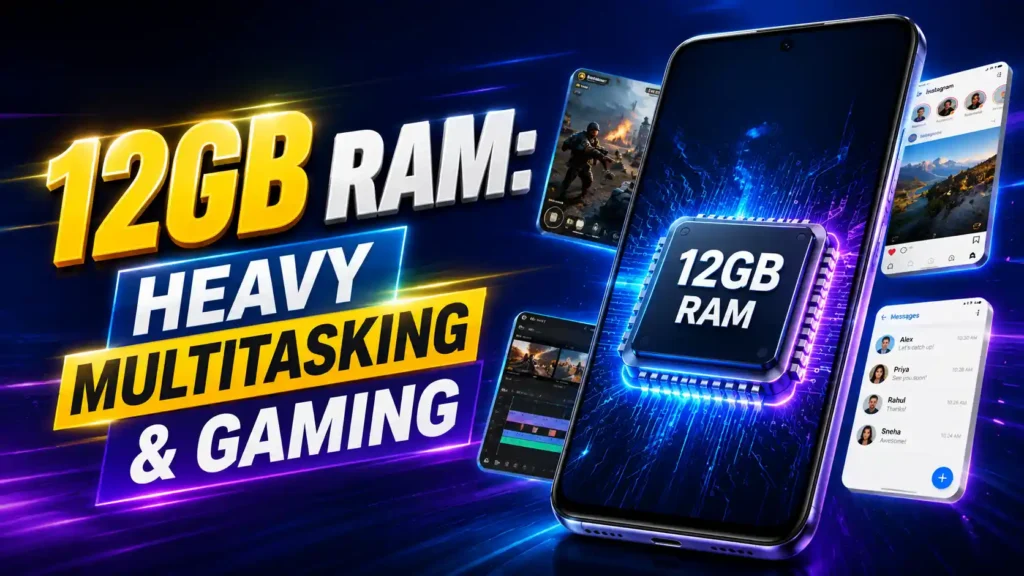
12GB RAM: Heavy Multitasking & Gaming
Upgrading to 12GB gives additional memory for more demanding workloads.
Heavy gamers, content creators, and those who routinely run numerous applications at the same time will profit from the added capacity.
A user may be playing a heavy game, chatting with friends, browsing the web, and editing everything at the same time. More RAM means the operating system can be less aggressive in killing background programs. But the benefit depends very much on the software and CPU.
If your daily routine is primarily chatting, YouTube, web surfing, and social media, you may not see a big difference between 8GB and 12GB.
16GB RAM: Who Really Needs It?
The 16GB RAM is becoming more common on luxury and gaming smartphones.
This can be handy for those who need more out of their equipment. Gamers running demanding titles, artists working with enormous files, and those who frequently multitask across demanding applications will all benefit from the extra memory.
It may also provide additional headroom for innovative software and AI-related tasks. But for the ordinary smartphone user, 16GB is usually more than enough.
If your major hobbies are calls, messaging, social media, taking photos, streaming, and occasional gaming, you might not see a significant difference by shelling out more for 16GB.
What about phones with 24GB RAM?
Some premium gaming- and performance-oriented smartphones are advertised with 24 GB of RAM. On the face of it, this figure can look impressive, especially when contrasted with the 4GB or 6GB options seen in inexpensive handsets.
Such big memory configurations are mostly aimed at enthusiasts and users with specific workloads. Phones built for gaming and other high-performance devices often combine big amounts of RAM with powerful processors, fast storage, and sophisticated cooling systems.
But for the average smartphone user, 24GB of RAM is way more than they need.
Just because you have 24GB doesn’t guarantee that every single app is going to operate 3 times faster than on an 8GB phone. In order for the extra capacity to be a real advantage, applications must actively employ the increased memory.
Does More RAM Make a Phone Faster?
This is one of the biggest myths about smartphone specs. More RAM does not mean a faster smartphone.
The processor (sometimes known as the chipset) is the core component that processes calculations and runs apps. Faster storage also matters, because it can cut load times and make a system more responsive in general.
RAM is the primary constraint on the amount of active information that may be kept quickly accessible.
Imagine two mobile phones:
- Phone A contains 8GB RAM and a new strong processor.
- Phone B has 16GB of RAM but a much lesser processor.
All else being equal, just doubling the RAM doesn’t mean that Phone B will be faster.
Software optimization also counts. A phone that is well-optimized and has enough RAM will perform better than one that is not so well-optimized but has a higher memory specification.
Is RAM important for AI features?
RAM is becoming more significant as smartphone manufacturers add more advanced AI technologies.
Today’s smartphones can give AI-powered capabilities for photography, writing, translation, summarization, voice assistance, picture editing, and more. Some processing can be done locally on the device, while other processes may rely on cloud-based services.
AI workloads on devices can be memory-intensive, particularly when compared to loading and processing bigger models locally. Higher RAM configurations could become more useful as smartphone software becomes more AI-driven.”
RAM is not the only necessity, though. AI performance also depends on the dedicated AI hardware of the chipset, software optimization, and size and type of model being used.
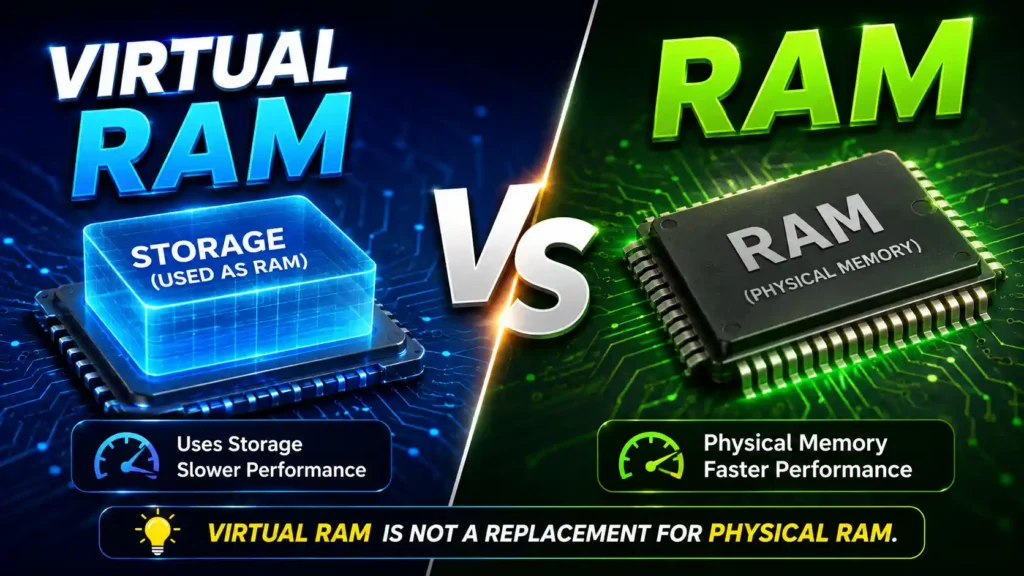
Virtual RAM vs RAM
A lot of smartphone brands advertise something called ‘virtual RRAM,’ ‘RAM expansion,’ ‘memory extension,’ or something similar.
This function enables you to use a portion of the internal storage as extra memory as needed. Note that virtual RAM is not the same thing as actual RAM.
Physical RAM is optimized for quick memory operations. Smartphone storage has varied performance characteristics. In some cases virtual RAM can be helpful (especially if you are memory-starved), but it is not a substitute for real RAM.
So, always check out the actual physical RAM arrangement first while comparing cellphones.
How much RAM should you get?
The amount you use will depend on your use.
For casual users: 4GB-6GB
If you’re mainly calling, messaging, surfing, streaming, and using lightweight apps on your smartphone, 4GB or 6GB can be sufficient.
For most users: 8GB RAM
8GB is a superb choice for regular smartphone users who desire smooth multitasking and solid long-term flexibility.
Heavy users: 12 Gb
If you’re the multitasking kind, play resource-intensive games, edit photographs or videos, or utilize resource-hungry apps, 12GB gives you some breathing room.
For the Enthusiast: 16GB+
If you’re a gamer, you run intensive workloads or just want as much memory as possible; choose a phone with 16GB or more.
For the average person: 24GB is unnecessary
For routine smartphone usage, unless you have a particular need for such a huge memory configuration, 24GB is overkill.
Should You Pay More for Extra RAM?
Not always.
If you are comparing two phones, compare the full specs, not just the RAM.
A phone with 8GB of RAM but a newer chipset, quicker storage, and better software optimization could deliver a better experience than a phone with 12GB or 16GB of RAM but inferior supporting hardware.
Consider the display quality, battery capacity, charging, cameras, storage, thermal management, software updates, and the overall quality of the gadget.
If the price of upgrading from 8GB to 12GB is cheap, the extra room may be worth it for long-term use. But for casual users, paying a hefty premium just for a bigger RAM quantity might not make sense.
Last Word
The smartphone industry has advanced considerably from the days when 2GB or 3GB of RAM was deemed plenty. The 6GB and 8GB combinations are still comfortable for many people today. The 12GB and 16GB are preferable for heavy multitasking, gaming, and demanding programs.
For most customers, 8GB is a good sweet spot. It has adequate RAM for regular use and plenty of headroom for multitasking and future software.
For the more demanding user, 12GB or 16GB are options, with 24GB variants largely being geared at enthusiasts and specialist use cases.
Above all, bear in mind that RAM is simply one piece of the overall performance puzzle in a smartphone. A fast processor, efficient software, fast storage, and smart heat management can be just as critical.
So instead of just asking, “Which phone has the most RAM?” ask a better question: “How much RAM do I really need for how I use my phone?”
For most users, the right answer will probably be a lot lower than the top figure written on a smartphone’s spec sheet.
Frequently Asked Questions (FAQs)
How much RAM is enough for a smartphone?
8GB of RAM is sufficient for normal use. Heavy users can consider 12GB or 16GB.
Do I need 16GB RAM on a smartphone?
Most users do not need 16GB, but heavy gamers and content creators can consider models with 16GB of RAM.
Does more RAM make a smartphone faster?
Not exactly. RAM is used mainly for multitasking and keeping apps running. Then there’s the processor, storage, software optimization and cooling which also affect overall speed.